

Essential Architectural Safety Basics for Stainless Steel Railings
TL;DR:
- Practicing comprehensive risk assessment beyond basic compliance helps ensure truly safe stainless steel railing systems.
- Design choices like material grade, fixings, and infill panels should be informed by site-specific risk considerations, not just standards.
Specifying a stainless steel railing system that clears the minimum height requirement feels like a job done. But that instinct, however common, leaves real gaps in fall protection that neither the inspector nor the client will catch until something goes wrong. Modern risk assessment methodologies go well beyond basic safety codes by modeling falling-from-height risks in a way that simple dimensional checks never will. This guide breaks down what architectural safety truly requires for stainless steel railings and parapets, and how Bulgarian architects and contractors can build both compliance and genuine protection into every project.
Table of Contents
- The core principles of architectural safety
- Legal standards versus risk assessment: What's required in Bulgaria
- Key safety components of stainless steel railings and parapets
- Practical strategies for safer construction projects
- Expert perspective: Why combining legal standards with risk modeling is essential
- How Inoxify can support your next safe project
- Frequently asked questions
Key Takeaways
| Point | Details |
|---|---|
| Beyond code compliance | Architectural safety requires both meeting standards and reducing real risks through proactive strategies. |
| Risk modeling matters | Modern risk assessment frameworks can significantly lower fall hazards compared to minimum-code solutions. |
| Material and installation quality | Choosing certified, high-quality stainless steel systems is essential but must be paired with professional installation. |
| Practical collaboration | Clear communication among architects, suppliers, and contractors is key for successful safety outcomes. |
The core principles of architectural safety
Many professionals treat safety as a checklist. Measure the height, confirm the gap between balusters, get the certification stamp, move on. That process handles legal exposure, but it doesn't always handle physical risk.
True architectural safety has two distinct layers. The first is regulatory compliance: meeting the minimum heights, maximum gap dimensions, load requirements, and material certifications set by Bulgarian building law and European standards. The second is proactive risk reduction: looking at the specific conditions of each site, each user group, and each use pattern, then making design decisions that reduce the probability of a real fall injury.
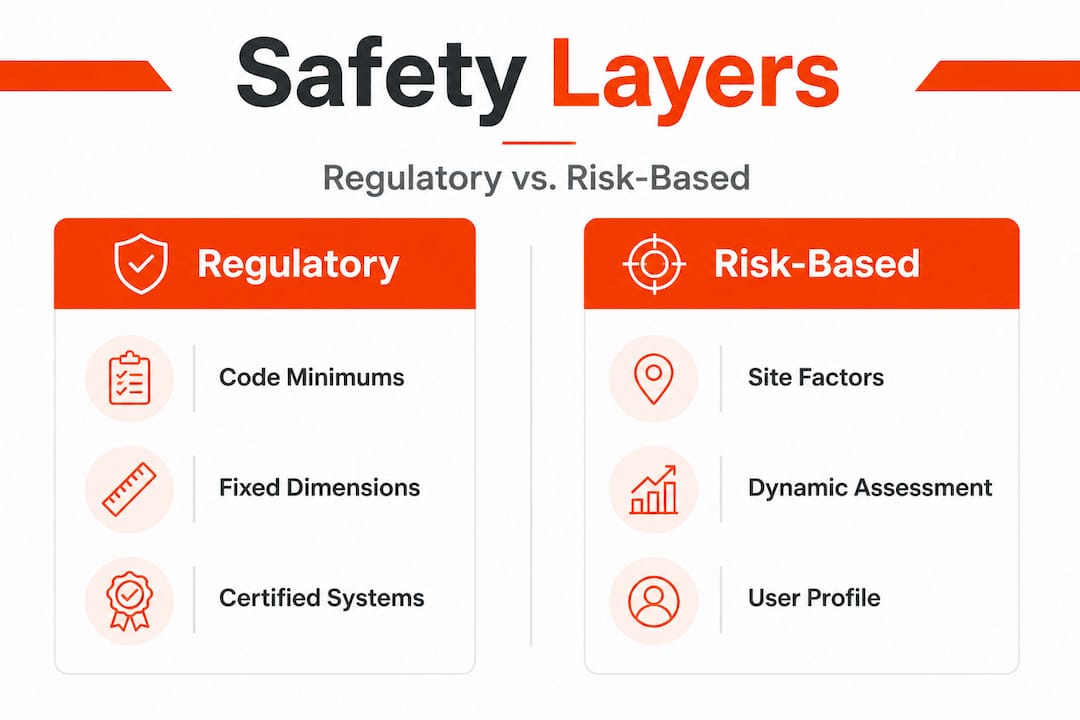
Understanding the role of railings in safety clarifies why this distinction matters in practice. A railing on an interior residential staircase and a parapet on a commercial rooftop terrace share the same minimum height code, but their risk profiles are completely different.
The core principles that guide genuinely safe railing specification include:
- Compliance baseline: Certified materials, verified installation, and dimensional conformance with current Bulgarian and European norms.
- Contextual risk analysis: Evaluating who will use the space, how often, and under what conditions, including children, elderly users, or crowded public settings.
- Load verification: Confirming that the fixing system, post spacing, and structural substrate can absorb the horizontal forces that a real human impact will generate.
- Ongoing inspection: Building in a schedule for checking corrosion, loose fixings, and connection integrity over the product's service life.
Research confirms that risk in construction can and should be quantified to properly address falling hazards, rather than relying solely on dimensional standards.
Staying current with building codes for railings is a starting point, but the professionals delivering the safest outcomes are the ones who treat those codes as a floor, not a ceiling.
Legal standards versus risk assessment: What's required in Bulgaria
With a clear understanding of these principles, it's important to see how local regulatory requirements and modern risk-based safety philosophies compare in practice.
Bulgarian law and supplier guidance focus on prescriptive technical requirements. These are specific, measurable, and enforceable. Bulgaria's supplier guidance is prescriptive and mainly focused on technical dimensions and certifications. In practical terms, that means the following legal benchmarks apply to most projects:
| Safety dimension | Legal/prescriptive standard | Risk-based approach |
|---|---|---|
| Minimum railing height | 90 cm (residential), 110 cm (public/commercial) | Height adjusted to user population and exposure level |
| Maximum baluster gap | 10 cm (child-safe spaces) | Gap analysis based on actual user profile and site traffic |
| Material certification | AISI 304 or 316 inox, CE-marked components | Material selection informed by environmental corrosion modeling |
| Load capacity | Meets EN 1991 horizontal load tables | Dynamic load modeling based on occupancy density |
| Installation | Fixed per manufacturer specification | Substrate testing and pull-out load verification before sign-off |
The risk-based column doesn't replace the legal column. It supplements it. Where prescriptive rules give you a fixed number, risk modeling gives you context. A balcony overlooking a busy pedestrian zone at height 15 meters presents a fall severity that justifies going beyond the minimum.
Pro Tip: When you start a project, document both layers. Note the legal minimum, then note the site-specific risk factor that informs your final specification. That documentation protects you legally and professionally if any future question arises.
Understanding where railings fit into building codes gives you the regulatory foundation. Layering risk assessment on top of that foundation is what separates ordinary compliance from solid, defensible safety design.
Key safety components of stainless steel railings and parapets
Comparing the two approaches makes one thing clear: the specific technical features you specify in a stainless steel railing or parapet system directly determine how much real risk reduction you actually achieve. Here's what matters most.
Material grade and surface finish
AISI 304 is the standard choice for interior applications and sheltered exterior spaces. AISI 316 adds molybdenum to resist chloride corrosion, making it the correct choice for coastal environments, swimming pool areas, and any exterior installation exposed to road salt or industrial pollution. Choosing the wrong grade doesn't create an immediate visible failure. It creates slow surface degradation that weakens load-bearing connections over time.
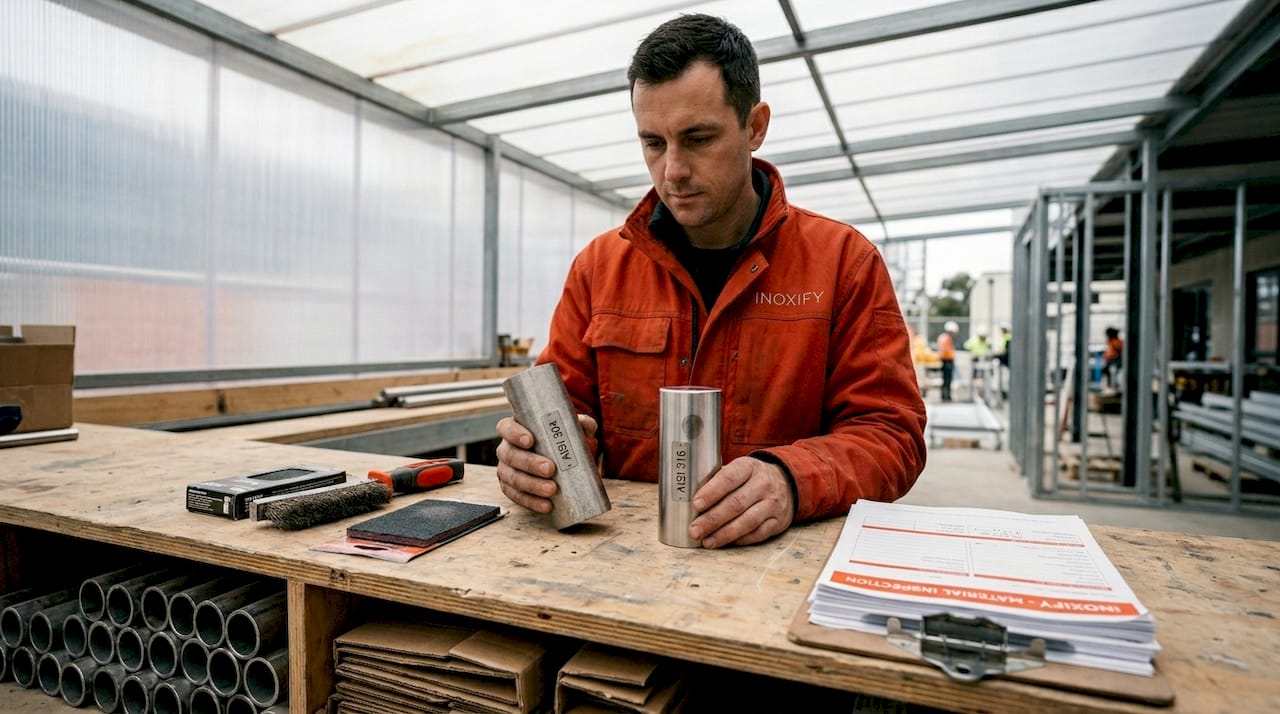
Surface finish matters too. A brushed satin finish (typically 240 grit) is easier to clean and inspect than a mirror polish, because surface defects and micro-cracks are easier to spot during routine maintenance checks.
Structural post and fixing design
Post spacing directly affects the horizontal load distribution across the railing run. Wider post spacing means each post and its fixing point carries a greater share of the total horizontal force during an impact event. For a standard residential balcony, 1.2 meter post spacing is common. For a high-traffic public terrace or stadium walkway, reducing spacing to 0.9 meters or specifying heavier-section posts provides meaningful load capacity improvement.
The fixing type is equally critical. Side-mount base plates spread the fixing load across a larger area of the substrate, which is important on concrete or masonry that may not offer consistent pull-out strength. Core-mount fixings, where the post inserts into a sleeve cast into the slab, provide superior rigidity but require precise coordination during the structural pour.
Infill panel selection and gap compliance
Human risk assessment should inform the specification of safety elements in railing design, including the infill choice. The three main options each carry specific risk implications:
- Horizontal cable infill: Elegant and open, but requires tension checks during installation and annual re-tensioning. Slack cables create compliant gaps that may not remain code-compliant under load.
- Vertical bar infill: Structurally straightforward and easier to maintain. Verify bar spacing precisely, especially in spaces that children access.
- Tempered glass panels: Provide a continuous, rigid barrier with no gap risk. Require laminated safety glass (minimum 6.6 mm VSG) and compliant point-fixing or channel systems to prevent panel ejection under lateral load.
| Feature | Risk mitigated | Specification note |
|---|---|---|
| AISI 316 grade | Long-term structural degradation | Mandatory for coastal/pool/industrial exposure |
| Laminated glass infill | Gap compliance failure, panel fragmentation | Minimum 6.6 mm VSG, channel or clamp fixed |
| 0.9 m post spacing | Excessive lateral deflection under crowd load | Required for public terraces, commercial spaces |
| Satin finish | Delayed detection of surface defects | Preferred for high-maintenance environments |
| Core-mount post fixing | Post rotation under impact | Preferred where substrate quality is verified |
The safest projects treat every line in that table as a deliberate decision, not a default. Architects and contractors who focus on railing design in the building context understand that each feature choice maps to a specific risk reduction outcome. Reviewing guidance on designing handrails for safety also helps you align aesthetic goals with structural requirements without compromising either.
Practical strategies for safer construction projects
Knowing the components is only part of the solution. Making safety real on site requires concrete process steps, not just product specifications.
Here is a proven implementation sequence that works across both residential and commercial project types:
- Define the risk environment early. Before selecting any product, classify the space: interior or exterior, public or private, general population or vulnerable user groups. This classification drives every downstream decision.
- Review Bulgarian and European code requirements. Pull the current applicable standards and document the minimums. This creates your legal baseline and reveals any gaps in your initial assumptions.
- Apply site-specific risk factors. Risk modeling helps project teams anticipate safety issues beyond basic regulations, reducing incidents. Translate that into your project by documenting height exposure, expected user density, and environmental conditions.
- Select compliant, certified components. Specify materials with documented CE certification, verified material grade, and traceable production origin. Local Bulgarian production simplifies traceability and speeds up documentation for building permits.
- Verify structural substrate compatibility. Before fixing any railing system, confirm the substrate pull-out capacity. A railing that meets every dimensional requirement but is fixed into degraded concrete provides no real protection.
- Conduct a pre-handover safety check. Walk every railing run with a simple checklist: height, gap, deflection under hand pressure, fixing tightness, and visible surface condition. Document and photograph.
- Communicate findings to all stakeholders. Architects, contractors, and clients all need the same safety documentation. Clear communication reduces the chance of post-handover modifications that compromise the original design.
Pro Tip: Build your safety checklist into the project handover package as a standard document. Clients who understand what was specified and why are far less likely to make uninformed changes later, such as removing a secondary handrail or widening a gate opening.
Consulting resources on top railing safety tips gives you additional practical input for site-level decisions. It is also worth considering that sustainable materials in railings can align long-term durability goals with environmental performance targets, which is increasingly relevant for green-certified projects in Bulgaria.
Expert perspective: Why combining legal standards with risk modeling is essential
The guidelines above give you a strong foundation. But experience with real projects reveals something worth stating plainly: prescriptive rules alone create a false sense of security that can be more dangerous than no guidance at all.
When a code says 90 cm, it gives professionals a number to check off. That number was derived from population averages and typical fall scenarios. It does not account for the specific geometry of your site, the particular user group occupying the space, or the cumulative load that a crowded terrace generates on a Friday night. Following the number is necessary, but believing the number is sufficient is a professional risk.
Research shows that relying only on prescriptive dimensions is less effective than dynamically quantifying real risks. That finding should inform how architects and contractors approach every railing specification, not just complex or high-profile projects.
The professionals delivering the best safety outcomes in Bulgaria right now are not the ones who know the code better than everyone else. They are the ones who understand that the code describes a minimum acceptable condition under average circumstances, and they design beyond that minimum whenever the site context calls for it.
Dynamic risk modeling does not have to be an elaborate process. At its most practical, it means asking four questions before finalizing a specification: Who uses this space? What is the worst realistic fall scenario here? Does our current specification address that scenario? What would it cost to add one level of protection above the minimum? In most cases, the cost of specifying AISI 316 instead of 304, or reducing post spacing by 30 cm, or upgrading to laminated glass infill is marginal compared to the total project budget. The liability exposure of not doing so is not marginal at all.
Understanding the broader impact of modern railings on building performance reinforces this point. Railings are a permanent, load-bearing safety element. Treating them as a finishing detail rather than a structural decision is where many projects fall short.
How Inoxify can support your next safe project
Ready to put these safety principles into practice on your next project? Inoxify provides certified stainless steel railing and parapet systems produced locally in Bulgaria, designed to meet both the legal requirements of Bulgarian building regulations and the higher performance expectations that risk-informed design demands.
Our stainless steel railing systems are available in AISI 304 and 316 grades, with multiple infill and fixing configurations to match your specific project conditions. For terrace and balcony applications, our custom stainless steel parapets combine structural integrity with clean architectural lines. Whether you are working on a residential renovation or a large commercial build, we can help you select the right system, confirm compliance, and coordinate delivery directly to your site. Contact our technical team to discuss your project requirements and get a specification recommendation that covers both code compliance and real risk reduction.
Frequently asked questions
What is the minimum height required for stainless steel railings in Bulgaria?
Bulgarian standards typically require a minimum railing height of 90 cm for residential applications and 110 cm for public or commercial spaces, but you should always verify against the current local building permit requirements for your specific project type.
Is using certified systems enough to guarantee fall safety?
Certification confirms that a product meets dimensional and material standards under defined test conditions, but it cannot account for every site-specific risk factor. Adding a dynamic risk assessment layer to your specification process identifies hazards that certification alone does not address.
How can contractors integrate risk modeling into everyday construction projects?
Start by documenting the site's user profile and exposure conditions before selecting any product, then use that information to evaluate whether the compliant minimum specification is actually sufficient for that specific context. Partnering early with suppliers who understand both compliance requirements and risk-based design principles makes this process faster and more reliable.
What features should I prioritize when specifying stainless steel railings?
Prioritize certified material grade matched to the environmental exposure, verified post fixing compatibility with the structural substrate, gap compliance confirmed for the actual user group on site, and a documented pre-handover inspection process that covers all critical safety dimensions.
Recommended
- 7 Architectural Railing Inspiration Ideas for Designers - Inoxify
- Railing maintenance basics for contractors: ensure durable stainless s - Inoxify
- Custom Railing Solutions: Enhancing Safety and Style - Inoxify
- Role of Railings in Home Design: Safety Meets Style - Inoxify
Свързани страници в Inoxify
Разглеждайте нашите специализирани секции за оферти, цени с монтаж и техническа информация: