

AISI 304 steel for railings: properties, uses, and benefits
TL;DR:
- AISI 304 stainless steel is suitable for inland, covered, and indoor railing applications due to its corrosion resistance.
- Upgrading to AISI 316 is recommended for coastal or chloride-rich environments because of higher pitting resistance.
- Proper installation and regular maintenance significantly extend the lifespan and appearance of AISI 304 railings.
Not all stainless steel is created equal, and choosing the wrong grade for a railing project can lead to premature corrosion, costly replacements, and failed client expectations. In Bulgaria’s construction market, AISI 304 is the dominant inox grade used in railings and architectural metalwork, yet many contractors still apply it across every project without evaluating whether it’s truly the right fit. This guide cuts through the confusion, covering exactly what AISI 304 steel is, how its properties stack up against alternatives like AISI 316, and where it delivers the best value across interior, exterior, and balcony railing applications.
Table of Contents
- Understanding AISI 304 steel
- How AISI 304 compares to other stainless steels
- Benefits and best-use cases of AISI 304 steel in railings
- Installation and care tips for AISI 304 railings
- Expert perspective: When AISI 304 is the smart choice—and when it’s not
- Find the right AISI 304 railing solution with Inoxify
- Frequently asked questions
Key Takeaways
| Point | Details |
|---|---|
| Versatile construction material | AISI 304 is the most widely used stainless steel for indoor and inland railing projects in Bulgaria. |
| Cost-effective choice | In most inland environments, AISI 304 gives reliable corrosion resistance without the extra cost of higher grades. |
| Compare with AISI 316 | Upgrade to AISI 316 only when projects face aggressive weather or coastal exposure. |
| Proper installation matters | Correct installation and maintenance are essential to maximize the lifespan of AISI 304 steel. |
Understanding AISI 304 steel
AISI 304 is the most widely specified grade of stainless steel in the world, and for good reason. It belongs to the austenitic family of stainless steels, which means its crystal structure is face-centered cubic, giving it a strong combination of formability, toughness, and corrosion resistance. For construction professionals, this classification matters because austenitic grades are non-magnetic in the annealed state, easy to weld, and respond well to the forming and bending required in railing fabrication.
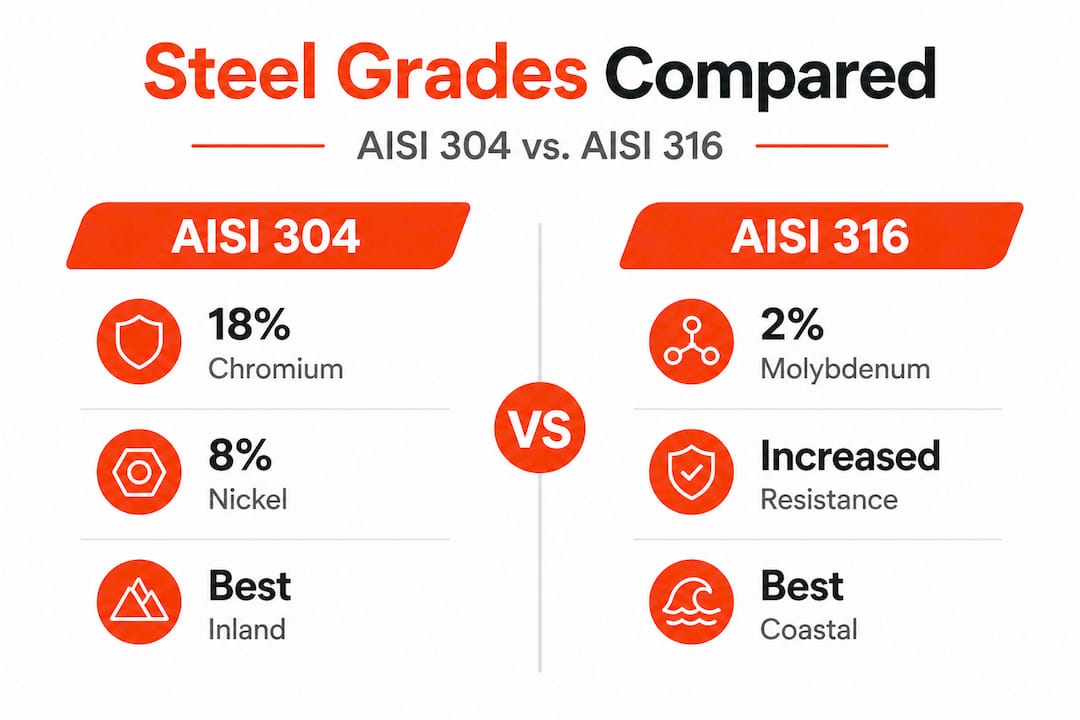
The grade is defined by its chemical makeup. AISI 304 contains 18% chromium and 8% nickel, a combination often referenced simply as “18/8 steel.” Chromium forms a passive oxide layer on the surface of the steel, and this invisible layer is what gives inox its characteristic resistance to rust and staining. Nickel stabilizes the austenitic structure and adds ductility, which makes the steel easier to work with during tube bending, laser cutting, and surface finishing. You can read a deeper breakdown of these advantages in this overview of AISI 304 steel advantages.
Here is a quick reference for the key physical and mechanical properties of AISI 304:
| Property | Value |
|---|---|
| Chromium content | 17.5–19.5% |
| Nickel content | 8–10.5% |
| Tensile strength | 515–720 MPa |
| Yield strength | 205 MPa (min) |
| Elongation at break | 40% |
| Max operating temperature | 870°C (intermittent) |
| Density | 7.93 g/cm³ |
The properties that matter most to railing contractors are its tensile strength, surface finish quality, and corrosion resistance in standard atmospheric conditions. AISI 304 handles these demands reliably in most inland and sheltered environments. Its main limitation is sensitivity to chloride exposure. In environments with high salt concentrations, such as coastal zones or swimming pool surroundings, the passive layer can be compromised, leading to pitting corrosion over time.
Key characteristics at a glance:
- Excellent formability for tube bending and profile shaping
- Good weldability without post-weld heat treatment in most cases
- Attractive brushed or mirror-polished surface finish
- Strong resistance to oxidation and atmospheric corrosion
- Moderate resistance to chlorides and acidic environments
How AISI 304 compares to other stainless steels
Having defined AISI 304 steel, it’s useful to see how it stacks up against popular alternatives, especially for railing projects. The most common comparison is 304 versus 316, and this decision comes up constantly when specifying railings for balconies, public buildings, and outdoor pedestrian areas.
The core difference lies in one element: molybdenum. AISI 316 includes 2–3% molybdenum in its composition, which significantly boosts pitting resistance with a PREN of 25–28, compared to AISI 304’s PREN of approximately 18–20. PREN stands for Pitting Resistance Equivalent Number, and a higher number means better performance in chloride-rich and aggressive environments. The trade-off is cost. AISI 316 is 20–50% more expensive than 304, making it a significant budget consideration for large railing projects.
| Feature | AISI 304 | AISI 316 |
|---|---|---|
| Chromium content | 18% | 16–18% |
| Nickel content | 8% | 10–14% |
| Molybdenum | None | 2–3% |
| PREN | ~18–20 | ~25–28 |
| Cost relative to 304 | Baseline | 20–50% higher |
| Best environment | Inland, covered, indoor | Coastal, pool areas, industrial |
| Corrosion resistance | Good | Excellent |
For most railing projects in Bulgarian inland cities such as Sofia, Plovdiv, and Veliko Tarnovo, AISI 304 delivers excellent performance at a lower price point. On the Black Sea coast, or in projects with direct exposure to pool water, saltwater spray, or industrial chemicals, AISI 316 for architecture is the more reliable specification. You can also review a detailed breakdown of AISI 304 vs 316 comparison to help guide client conversations.
“Choosing between 304 and 316 is not about which grade is better overall. It’s about matching the grade to the actual exposure conditions of the project. Specifying 316 for a covered indoor staircase is unnecessary spending. Specifying 304 for a coastal balcony railing is a risk you don’t want to take.”
Pro Tip: If your project site is within 5 kilometers of the coast or involves a saltwater pool or spa area, default to AISI 316 for all exterior inox elements. For every other location in Bulgaria, AISI 304 provides reliable performance at a meaningfully lower cost. This rule alone can help you justify material specifications to your clients with confidence. You can verify more about AISI 316 corrosion resistance if a client pushes back on the upgrade cost in borderline situations.
Benefits and best-use cases of AISI 304 steel in railings
Now that you know how AISI 304 stacks up to alternatives, let’s explore where it excels and how to leverage its strengths in your construction projects. When used in the right environment, AISI 304 is a genuinely strong performer that offers a combination of durability, aesthetics, and workability that few other materials can match at the same price.
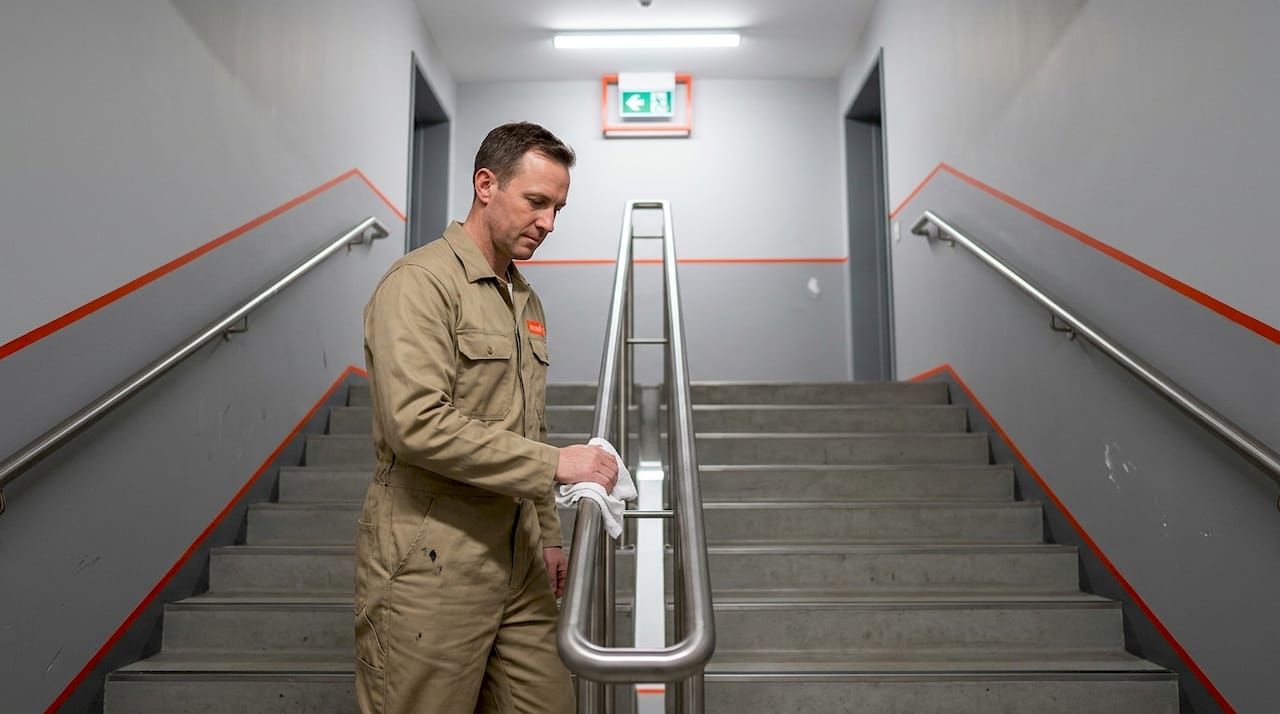
AISI 304 offers strong corrosion resistance for most indoor and inland applications at a substantially lower cost than AISI 316. This makes it the practical default for the majority of railing work you will encounter in Bulgaria’s residential and commercial construction market.
Primary benefits of AISI 304 for railing use:
- Corrosion resistance in standard conditions: The chromium oxide passive layer resists rust and staining in normal atmospheric environments, keeping surfaces clean and structurally sound over many years.
- Workability and fabrication flexibility: AISI 304 bends, welds, and finishes cleanly, making it compatible with tube railings, wire rope systems, glass parapet channels, and decorative profiles.
- Aesthetic quality: Both brushed (satin) and mirror-polished finishes hold up well over time, contributing to the clean, modern look that architects and clients expect from inox railings.
- Wide product availability: Because 304 is the global standard, components, fittings, and replacement parts are readily available, which simplifies sourcing for contractors.
- Long service life with proper maintenance: In appropriate environments, AISI 304 railings can remain structurally and visually sound for decades without major intervention.
Ideal use cases for AISI 304 railings:
- Interior staircases in residential and commercial buildings
- Covered outdoor walkways and building entrances
- Inland balcony and terrace parapets
- Shopping mall and hotel interior balustrades
- Office building interior handrails and guard rails
- Rooftop railings in low-corrosion, non-coastal areas
For projects in these categories, you can safely specify 304 and deliver reliable, attractive results without overspending the material budget. Review our railing durability tips for practical guidance on maximizing the service life of your installations, and use the contractor railing checklist to verify that your specifications are complete before ordering.
Statistic worth noting: On projects where AISI 316 would have been unnecessarily specified, switching to AISI 304 can reduce material costs by 20–50% with no measurable difference in performance over the railing’s service life. For a mid-size balcony railing project with 30–50 linear meters of tube and fittings, that difference can amount to thousands of levs in savings.
Installation and care tips for AISI 304 railings
Selecting the right material is only the first step. Correct installation and care are essential to deliver successful, long-lasting railings. Even the highest-quality inox can underperform if it’s installed poorly or maintained inconsistently. These are the practical steps and practices that separate average installations from those that hold up and look great years down the line.
Installation workflow summary:
- Plan fastener placement carefully: Use stainless steel anchors and fasteners throughout. Mixing carbon steel hardware with stainless steel tubes accelerates galvanic corrosion at contact points.
- Protect the surface during cutting and grinding: Shield adjacent inox surfaces from sparks and debris. Carbon steel particles that land on 304 can cause surface rust spots that are difficult to remove.
- Clean welds thoroughly: After welding, remove scale and oxidation from the heat-affected zone using a stainless steel brush or pickling paste. This restores the passive layer and prevents localized corrosion.
- Use silicone or EPDM isolation between inox and concrete or masonry: Direct metal-to-concrete contact in wet conditions can trap moisture and cause staining.
- Check alignment before anchoring: Small misalignments that seem minor during assembly become visually obvious once the railing is in place and lit by natural light.
For a full step-by-step guide, see our detailed installation guide for stainless railings, which covers common bracket configurations and fixing methods. The outdoor installation workflow is especially useful for multi-level terrace and façade projects.
Maintenance checklist for AISI 304 railings:
- Wash with mild soap and water every 3–6 months in standard environments
- Use a soft cloth or non-abrasive sponge to avoid scratching the surface finish
- Remove any carbon steel residue or rust staining promptly using a dedicated inox cleaner
- Inspect all fixing points, especially at concrete anchors, for signs of moisture intrusion annually
- Avoid using bleach or chlorine-based cleaners, which can damage the passive layer
- Re-polish high-traffic handrail sections if surface scratches accumulate over time
Proper installation and regular cleaning significantly extend the lifespan of AISI 304 railings, particularly in environments where surface contamination is a risk. The easy railing features guide covers smart product choices that simplify both the initial installation and ongoing maintenance.
Pro Tip: One of the most common mistakes contractors make is using the same grinding discs and brushes on inox that they previously used on carbon steel. This transfers iron particles onto the stainless surface, which then oxidize and appear as rust. Always use tools dedicated exclusively to stainless steel work.
Expert perspective: When AISI 304 is the smart choice—and when it’s not
Here is something that experience in real projects reveals: most railing failures with AISI 304 are not material failures. They are specification failures. The steel itself performs exactly as expected. The problem is that it was specified in a context where those expectations didn’t match the actual conditions.
Contractors sometimes default to 304 for every project because it’s familiar and widely available. Others upgrade to 316 everywhere because a client read something online and asked for “the better steel.” Neither approach is actually professional. The right approach is a structured assessment: Where is the project located? What is the real exposure level? What are the client’s long-term expectations for maintenance costs and appearance?
Use 304 inland to save; only upgrade to 316 where necessary for coastal and aggressive environments. This is the professional standard, and it gives you a defensible position when clients ask why you chose one grade over the other. For a side-by-side look at how these choices play out in actual projects, the real-world 304 vs 316 examples page is a useful reference to share with clients.
The harder truth is that clients rarely focus on the grade designation in the specifications. What they notice is whether the railing looks good in three years, whether it shows rust near the wall anchors, and whether it’s easy to clean. AISI 304, correctly installed and maintained, delivers on all three in the right environment. The professional’s job is to know which environment they’re working in, make the grade decision accordingly, and communicate that reasoning clearly. That confidence and transparency is what builds long-term client relationships.
Find the right AISI 304 railing solution with Inoxify
For professionals ready to put these insights into practice, here’s how Inoxify can help you deliver long-lasting, high-quality AISI 304 railing projects.
Inoxify.bg produces and supplies a full range of stainless steel railing systems designed specifically for the Bulgarian construction market, with short lead times and ready-to-install configurations that save time on site.
Whether you’re specifying rounded railing systems for a staircase or sourcing balcony railing options for a residential terrace project, Inoxify offers products manufactured locally in Bulgaria with direct quality oversight. Every system is available in AISI 304 as the standard grade, with upgrade options to AISI 316 where your project requires it. Browse the full catalog of AISI 304 railing solutions or get in touch directly to discuss dimensions, system types, and delivery schedules for your next project.
Frequently asked questions
Is AISI 304 stainless steel suitable for outdoor railings in Bulgaria?
AISI 304 is ideal for most outdoor railings in inland and low-corrosion environments across Bulgaria. For coastal projects or areas with exposure to aggressive chemicals, upgrading to 316 is recommended for reliable long-term performance.
What is the main difference between AISI 304 and AISI 316 steel?
AISI 316 contains added molybdenum, which improves its pitting resistance and makes it better suited to coastal and chloride-rich conditions. This addition makes it 20–50% more expensive than AISI 304, so specifying 316 only where genuinely needed is the cost-effective approach.
How can you maintain the shine and durability of AISI 304 railings?
Regular washing with mild soap and water, combined with avoiding chloride-based cleaners and promptly removing surface contaminants, will keep the railing looking clean and corrosion-free. Proper installation and regular cleaning are the two most impactful factors in extending the service life of any inox railing.
Can AISI 304 steel be used for balcony railings?
Yes, AISI 304 is a strong choice for balcony railings in non-coastal locations. It offers strong corrosion resistance for inland and covered outdoor environments at a meaningfully lower cost than AISI 316.
Recommended
- AISI 304 неръждаема стомана: предимства за перила – Inoxify
- Stainless Steel vs Aluminum Railings: Choosing Wisely – Inoxify
- Sustainable Materials in Railings: Why Architects Choose Steel – Inoxify
- Stainless steel railing tips for durable projects 2026 – Inoxify
Свързани страници в Inoxify
Разгледайте нашите специализирани секции за оферти, цени с монтаж и техническа информация: